
Carpenter ants and termites can both damage your home, but they leave different signs and require different treatments. Carpenter ants have a pinched waist, elbowed antennae, and smooth wood galleries with coarse frass. Termites have a broad body, straight antennae, and may leave mud tubes or piles of equal-length discarded wings.
I learned how easily these pests can be confused during a North York inspection when a homeowner thought she had termites, but the evidence pointed to carpenter ants. After 15 years of pest-control work across the GTA, I’ve seen why identifying the right pest matters before choosing a treatment.
If you’re seeing signs of either pest in your home, Pest Removal Toronto can help identify the problem, assess the extent of the infestation, and recommend the right treatment. In this guide, you’ll learn how to tell carpenter ants from termites, what their damage looks like, which can cause more structural damage, and what to do if you find them in your home.
Why This Difference Matters in Toronto and the GTA
Misidentifying a wood-destroying insect can lead to the wrong response. In Ontario, carpenter ants are common, while termites have a more limited regional distribution. The Canadian Conservation Institute identifies termites as a regional hazard in southern Ontario, and Health Canada notes that termites occur only in certain parts of Canada. That means homeowners should not assume every wood-damaging insect is a termite or automatically dismiss termite evidence because they live in the GTA.
The original article’s first-hand GTA experience is a useful differentiator. Keep the North York inspection story, but use it as supporting context after the direct answer rather than making readers wait for the main distinction.
Carpenter Ants vs Termites: Key Differences
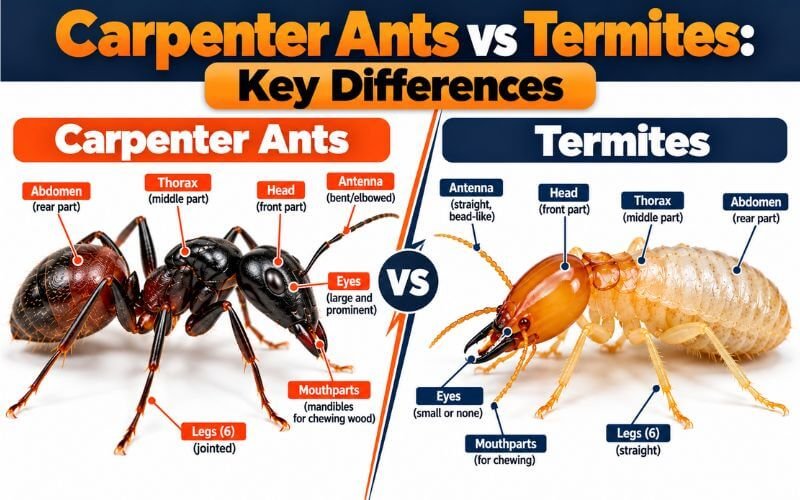
| Feature | Carpenter Ants | Termites |
|---|---|---|
|
Body shape |
Narrow, pinched waist |
Broad, relatively straight body; no pinched waist |
|
Antennae |
Elbowed/bent |
Straight, beaded |
|
Winged adults |
Front wings longer than hind wings |
Four wings similar in length and longer than the body |
|
Colour |
Often black, dark brown or reddish-black |
Workers are pale/creamy; swarmers are darker |
|
Wood use |
Excavate galleries for nesting; do not eat wood |
Consume cellulose in wood |
|
Wood damage |
Smooth, clean galleries; sawdust-like frass may be expelled |
Damage may be hidden; shelter/mud tubes can be associated with subterranean termites |
|
Key exterior clue |
Frass/sawdust-like shavings and slit-like openings |
Mud tubes; discarded equal-length wings can also be a warning sign |
|
Typical visibility |
Workers may forage indoors/outdoors |
Workers usually stay hidden; swarmers are more likely to be noticed |
How to Tell Carpenter Ants and Termites Apart
1. Body Shape
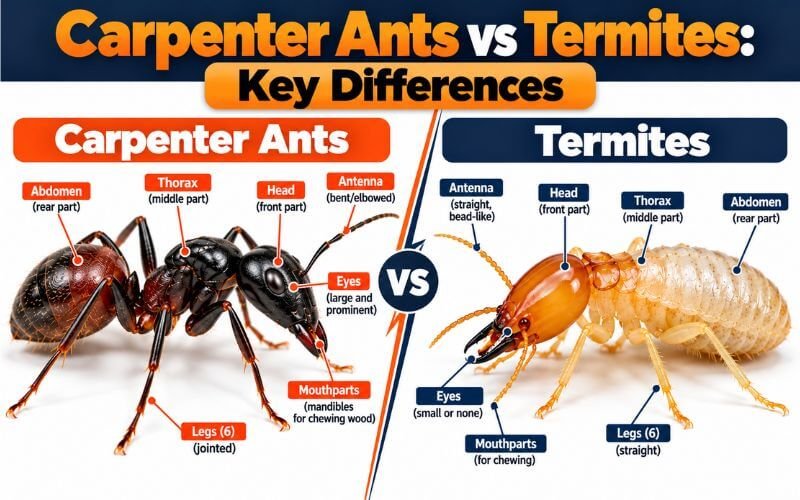
Carpenter ants have a distinctly narrow waist. Termites have a broader body without the constriction that makes an ant look hourglass-shaped. Body shape is one of the most useful first checks when a homeowner finds a winged insect.
2. Antennae
Carpenter-ant antennae are elbowed or bent. Termite antennae are straight and bead-like. This is often easier to identify than colour alone.
3. Wings
Winged carpenter ants have unequal wing lengths, with the front pair longer than the hind pair. Winged termites have four wings that are approximately equal in length. Termite wings also detach readily and may accumulate near emergence points.
4. Colour and Size
Colour can help, but it should not be used by itself. Health Canada describes carpenter ants in Canada as roughly 6–25 mm depending on type/caste, while worker termites are pale and winged termites are darker. Use colour together with body shape, antennae and wings rather than relying on size alone.
What Carpenter Ant and Termite Damage Looks Like
What Carpenter Ant Damage Looks Like
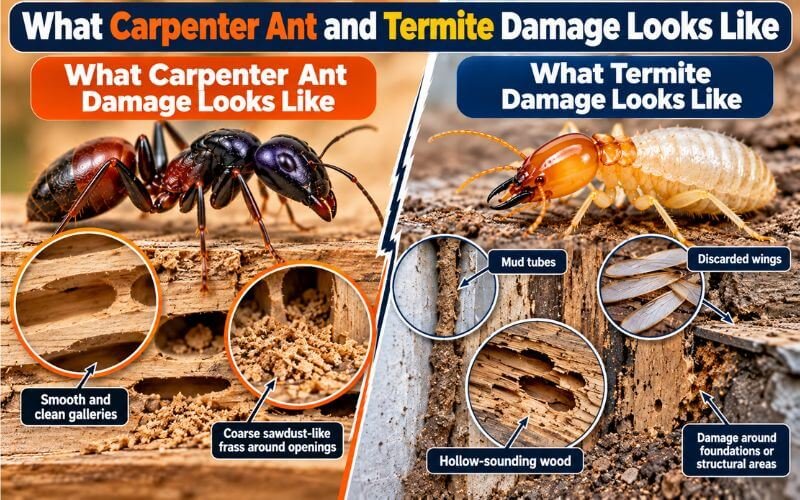
Carpenter ants excavate wood to build nesting galleries rather than eat it. Their galleries are often smooth and clean-looking, and you may find coarse sawdust-like frass around small openings where the ants push debris out. They also commonly nest in wood affected by moisture, leaks, or decay.
If you see these signs in your home, professional carpenter ant control in Toronto can help identify the nest, assess the infestation, and address the conditions attracting the ants.
What Termite Damage Looks Like
Termite damage can be harder to spot because much of the activity may happen inside or beneath the surface of the wood. Mud tubes, discarded wings, hollow-sounding wood, and other signs around foundations or vulnerable structural areas can indicate termite activity.
If you suspect termites, professional termite control in Toronto can help determine whether termites are active, identify where they are entering the structure, and recommend the appropriate treatment.
Which Causes More Structural Damage?
The answer depends on the infestation and building conditions, but the damage mechanism is different. Carpenter ants excavate wood for nesting and can weaken wood when colonies persist. Termites consume wood as a food source and can cause substantial structural damage where established.
Avoid using a fixed timeline such as ‘two to four years’ because damage rate varies with colony size, species, moisture and building conditions.
Can Carpenter Ants and Termites Infest the Same Home?
It is possible for different wood-associated pests to occur at the same property. Finding carpenter ants therefore does not, by itself, prove that termites are absent. If mud tubes, discarded termite wings or other termite evidence is present, the property should be evaluated for termite activity rather than relying on the ant identification alone.
When Are Carpenter Ants and Termites Active in Ontario?
Carpenter ants are commonly noticed during spring and warmer months, and workers are often active after sunset. Winged adults may appear during the spring swarming period. Termite activity and swarming are more dependent on species and local conditions, so avoid promising a single province-wide date range.
How Are Carpenter Ants Treated?
Effective carpenter-ant control starts with correct identification and locating the nest or nesting areas. A professional inspection may look for moisture-damaged wood, wall voids, satellite nests and exterior parent-colony sites. Treatment can involve targeted control of the nest, removal or repair of damaged/decaying wood, and correction of moisture conditions that make the property attractive to carpenter ants.
Health Canada and extension guidance both emphasize moisture correction, removal of decaying wood and professional control where nests are difficult to locate
How Are Termites Treated?
Termite treatment depends on the species, location, extent of activity and construction of the property. A professional assessment should establish whether termites are active, where they are accessing the structure and whether structural damage is present.
Treatment may be paired with moisture management, correction of soil-to-wood contact and repairs to damaged components. Product choice and application should follow the applicable Canadian/Ontario label and professional requirements.
How Much Does Treatment Cost in Toronto?
Avoid publishing a single universal price. Treatment cost can vary substantially depending on property size, pest species, nest location, accessibility, infestation extent, treatment method, follow-up requirements and structural repairs.
A useful commercial-intent section should explain these variables and invite homeowners to request an inspection or quote rather than presenting an unsupported fixed number.
Carpenter Ants vs Termites: Signs at a Glance
| What You See | Carpenter Ants | Termites |
|---|---|---|
|
Sawdust-like material |
Frass/shavings near galleries |
Not a typical primary sign |
|
Mud tubes |
Not a defining sign |
Important warning sign for subterranean termites |
|
Waist |
Pinched |
Broad/no pinched waist |
|
Antennae |
Elbowed |
Straight |
|
Wings |
Front longer than hind |
Four wings similar in length |
|
Wood galleries |
Smooth/clean |
May be associated with soil/mud material |
|
Indoor workers |
Can be seen foraging |
Workers usually hidden from light |
Prevention: Keeping Both Pests Out
- Control moisture: repair leaks, drainage problems and water-damaged wood.
- Keep firewood and decaying wood away from the building and off the ground.
- Reduce direct wood-to-soil contact where practical.
- Trim vegetation and branches that create easy routes to the structure.
- Seal cracks and gaps around likely entry points while addressing the underlying moisture or wood condition.
- During an older-home purchase, consider a wood-destroying-insect inspection in addition to a standard home inspection.
When to Call a Professional
Professional identification is especially appropriate when you find repeated frass, mud tubes, multiple winged insects indoors, unexplained wood damage, or activity inside walls. The goal is not simply to kill visible insects; it is to identify the pest, locate the source, determine whether structural components are affected, and address conditions that support the infestation.
Frequently Asked Questions
Sawdust-like debris near baseboards is usually a sign of carpenter ants, which leave behind wood shavings called frass as they tunnel through damp wood. Termites typically leave mud tubes and hollow wood instead of visible sawdust piles.
Carpenter ants are not dangerous to humans and rarely bite, but they can cause serious structural damage to homes over time. Large colonies tunnel through wood inside walls, floors, and roof structures if left untreated.
Winged insects swarming indoors in spring often indicate a termite or carpenter ant colony nearby. If they’re coming from walls, windows, or baseboards, it’s a strong sign the colony may already be inside the home.
No. They excavate wood to create nesting galleries; the wood is removed as they tunnel rather than consumed as their food.
Look first at the waist, antennae and wings. Carpenter ants have a narrow waist, elbowed antennae and unequal wing lengths. Termites have a broad body, straight antennae and four similar-length wings.