
Late one November, I got a call from a homeowner in Scarborough who told me she had a mouse problem. She’d found droppings near her kitchen stove, heard scratching in the walls at night, and had already bought two packs of small snap traps from the hardware store. None of them had caught anything in ten days.
When I arrived and had a proper look around, I found smear marks, dark, greasy streaks along the baseboard behind her fridge. I checked the gap beside the dryer vent. Then I went down to the basement and found something that confirmed my suspicion immediately: burrow signs near the base of the foundation wall, and droppings that were roughly the size and shape of a raisin.
This wasn’t a mouse problem. She had Norway rats.
The traps she’d bought were too small. The bait she’d placed was in the wrong spots. And the entry points she needed to seal were completely different from what a mouse would use. She’d spent two weeks treating the wrong pest.
That’s the thing about rodent identification, it’s not just an interesting exercise. Getting it wrong costs you time, money, and gives the infestation weeks more to grow inside your walls. In my fifteen years of pest control work across Toronto, Brampton, the single most common mistake I see homeowners make is assuming they have mice when they actually have rats , or the reverse.
This guide covers everything you need to know to correctly identify Mice vs. Rats, which rodent you’re dealing with before you spend a dollar on treatment.
Table of Contents
Why Correct Rodent Identification Matters

Let me be direct about this: mice and rats are not just different sizes of the same problem. They are separate species with different behaviours, different nesting habits, different food preferences, and different levels of caution around new objects in their environment. The traps that catch mice reliably will often go ignored by rats for weeks. The bait placements that work for rats will miss mice entirely if you don't understand their movement patterns.
Mice are curious and bold. They’ll explore new objects, including traps, within a day or two of them appearing. Rats, on the other hand, are notoriously neophobic, meaning they have a strong instinctive fear of anything new in their environment. A freshly placed trap near a rat runway may sit untouched for a week or more while the rat cautiously observes it. If you’re using a mouse-sized snap trap and wondering why nothing’s happening, there’s a good chance you’re dealing with rats that are simply too cautious to engage.
Entry point size is another critical difference. Mice can squeeze through a gap as small as six millimetres, roughly the width of a pencil. Rats need a larger opening, typically about half an inch or more, but they can also gnaw through wood, drywall, and soft metals to create their own entry points if motivated. Sealing the wrong-sized gaps and missing the others means your exclusion work is wasted.
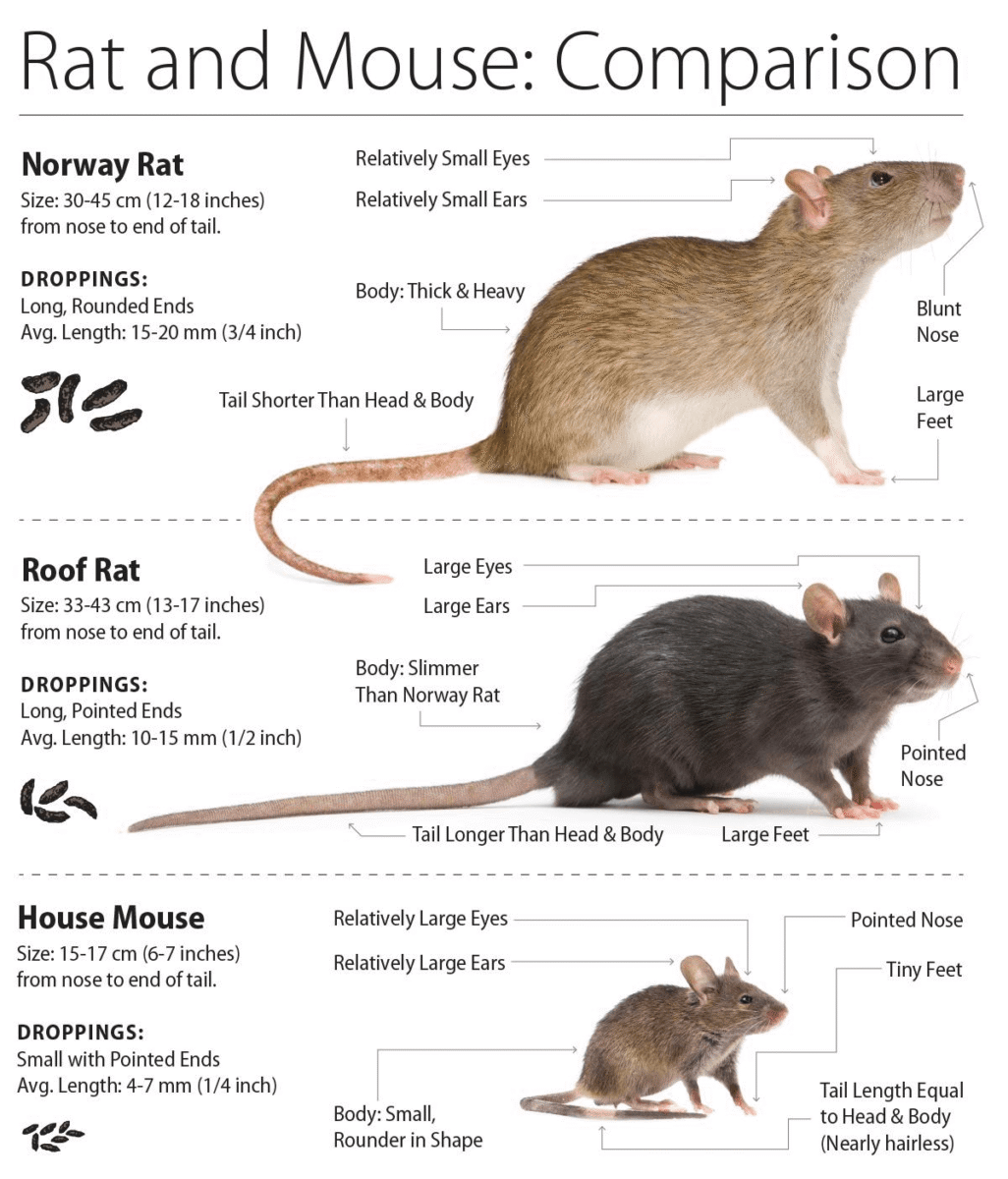
In Ontario specifically, we deal with two primary rodent species most of the time: the house mouse (Mus musculus) and the Norway rat (Rattus norvegicus), also called the brown rat. The roof rat (Rattus rattus), or black rat, is less common in our climate but does occasionally show up, particularly in older structures near ports or rail yards in the Toronto area. Knowing which of these you have changes everything about how you approach the problem.
Physical Differences: How to Tell Mice and Rats Apart
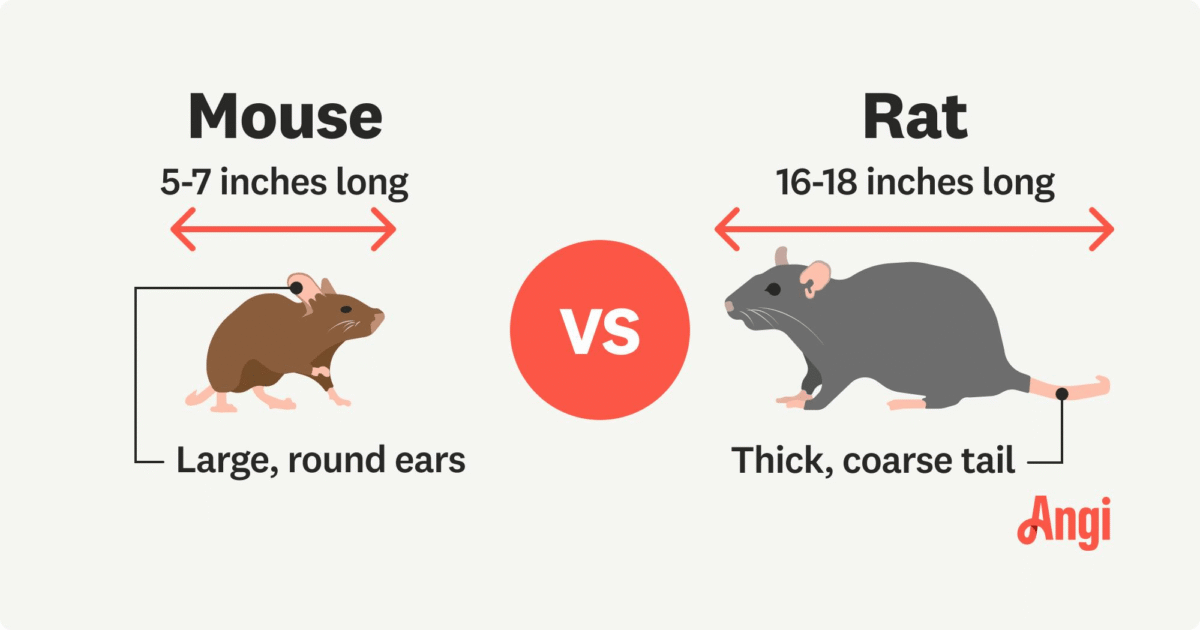
If you can actually see the animal, identification is usually straightforward provided you know what you’re looking at. Here’s exactly what I check on every call:
| Feature | 🐭 Mouse | 🐀 Rat |
|---|---|---|
| Size | 5–10 cm body, under 30 g — small and delicate | 20–25 cm body, 200–500 g — noticeably heavy and sturdy |
| Head shape | Triangular, pointed snout — angular and sharp | Blunt, rounded snout — broader and heavier-set |
| Eyes | Large and round relative to head — often described as “cute” | Smaller relative to head — less prominent |
| Ears | Large, floppy — disproportionately big for the head size | Smaller, sit closer to the head — less prominent |
| Tail | Thin, hairy, flexible — same length as body | Thick, scaly, hairless — like a rubber hose segment |
| Fur | Soft, uniform light brown to grey — smooth coat | Coarser, shaggier brown-grey (Norway) or dark brown to black (Roof rat) |
| Juvenile trap | Proportional features — balanced head, small neat feet | Large head and oversized feet relative to body — the key juvenile rat tell |
One thing worth highlighting from that last row, the juvenile rat vs. adult mouse confusion is the mistake I see most often in the field. A young rat at two to three weeks old can be roughly the same body size as an adult mouse, and I’ve had many homeowners in Mississauga and North York confidently tell me they’d seen mice when what they actually spotted was a young rat. The tell is always the feet and head: a juvenile rat looks slightly out of proportion, stubby, blunt face, paws that seem too big for the body. An adult mouse, by contrast, looks balanced and fine-featured all the way through.
How to Identify Which Rodent You Have by the Evidence They Leave Behind
Most of the time, you won’t see the rodent itself, at least not clearly or for long enough to study it. What you will find is the evidence they leave behind. This is what I focus on during every rodent inspection, and it’s genuinely more reliable than trying to catch a glimpse of the animal.
Droppings — The Single Most Reliable Sign
Rodent droppings are almost always the first evidence homeowners find, and they’re the best single indicator of which species you’re dealing with.
Mouse droppings are small about six millimetres long, roughly the size of a grain of rice with pointed ends. They’re dark brown to black when fresh, and they’ll be scattered in larger numbers because mice produce fifty to seventy-five droppings per day. You’ll find them concentrated near food sources, along travel routes, and in nesting areas.
Rat droppings are significantly larger, twelve to twenty millimetres long, with a shape that’s more blunt and capsule-like. Norway rat droppings in particular have rounded ends and a somewhat banana shape. Roof rat droppings are slightly smaller than Norway rat droppings and may have more pointed ends with a slight curl.
The quantity also tells a story. Finding a large scatter of small, rice-grain droppings near your kitchen cupboards is classic mouse behaviour. Finding larger, well-spaced droppings along a basement wall or near the foundation is almost always rats.
Always use gloves when handling or cleaning droppings. Both mice and rats can carry pathogens in their waste, including Hantavirus from mouse droppings and Leptospirosis from rat urine. These are genuine health risks, not just theoretical ones. Dampen the area with a disinfectant spray before sweeping or wiping never dry sweep rodent droppings, as this can aerosolize particles.
Gnaw Marks
Both mice and rats gnaw constantly; their incisor teeth grow continuously, and they need to wear them down. But the marks they leave are noticeably different.
Mouse gnaw marks are small and fine neat, clean edges on food packaging, wood, or wiring insulation. If you find a chewed corner on a cereal box or a small hole in a bag of rice, that’s typically mouse work.
Rat gnaw marks are larger, rougher, and more forceful. Rats have significantly stronger jaw muscles and larger teeth, and the damage they leave reflects it in ragged, rough edges on wood, larger holes in packaging, and in severe cases, gnaw damage on pipes, conduit, and even soft metals. I’ve seen Norway rats chew through lead pipe connections in older Toronto homes. If you’re finding large, rough gnaw holes, you’re almost certainly dealing with rats.
Smear Marks and Grease Trails
This is one of the most definitive signs of rat activity specifically and most homeowners don’t know to look for it.
Rats have oily, greasy fur, and they tend to travel the same routes repeatedly, pressing their bodies against walls and baseboards as they move. Over time, this deposits a dark, greasy smear mark along their regular runways. You’ll typically find these along the base of walls, around entry point edges, and along pipes or beams that rats use as travel routes.
Mice leave much lighter smear marks sometimes barely noticeable because they’re smaller and their fur is less oily. If you’re finding distinct, dark greasy smudges along your basement walls or behind appliances, that’s a strong indicator of rats.
Sounds in the Walls
The sounds rodents make in walls can also help with identification, though this takes some familiarity.
Mice produce a lighter scratching or scurrying sound, higher-pitched, and typically concentrated in walls and ceilings. Because mice are agile climbers, you might hear them in upper wall cavities or above ceiling panels.
Rats produce louder, heavier sounds , a more distinct thudding scurry, and sometimes gnawing or digging sounds. Norway rats are ground-level rodents, so you’re more likely to hear them in lower wall cavities, under floors, and in the basement. Roof rats, if present, do climb and may be heard in attic spaces or upper floors.
I’ve had clients in toronto describe the sound as “something the size of a squirrel” moving around in their walls at night. Nine times out of ten, that’s Norway rats, not mice, and not squirrels.
Nesting Material
Both mice and rats build nests from shredded soft material, paper, insulation, fabric, cardboard. Mouse nests tend to be small, compact, and well-hidden in tight enclosed spaces: inside walls, behind appliances, in drawers, inside boxes of stored goods.
Rat nests are larger and often found in different locations. Norway rats nest primarily at ground level, under concrete slabs, in burrows along foundation walls, beneath decking and sheds, or in basement wall voids. Their outdoor burrows are a distinctive sign: rounded entrance holes, typically five to eight centimetres in diameter, often with a smooth, worn-down entrance and a scatter of loose soil nearby.
Roof rats, when present, nest higher up, in attic insulation, in the upper sections of wall voids, in dense shrubs, and in trees near structures.
Runways and Travel Paths
Rats in particular establish fixed travel routes called runways, that they use consistently night after night. These paths are often visible as worn trails through insulation, dark smear marks along walls, or greasy tracks in dusty areas. If you place a thin layer of talcum powder or flour across a suspected runway, you can check for footprints the next morning. Rat footprints are larger and show the impression of a heel. Mouse footprints are tiny and delicate.
Mice vs. Rats in Ontario — Seasonal Patterns and Local Context
Here’s something that’s specific to our climate in the GTA that I don’t see discussed often enough.
In Ontario, rodent pressure on homes peaks between October and March. As temperatures drop, both mice and Norway rats seek warmth, food, and shelter and our homes offer all three. I see a significant spike in rodent calls every autumn, typically starting in mid-October when the first cold nights arrive.
House mice are the year-round rodent issue in the GTA. They don’t hibernate, they breed prolifically a single female can produce eight to ten litters per year, with five to six pups each and they can establish a thriving colony inside a wall void within weeks of finding an entry point.
Norway rats become particularly problematic in autumn and winter in Toronto. They’re ground-level rodents that burrow extensively outdoors during warmer months, but cold weather drives them inside. Urban construction in the GTA particularly the ongoing development downtown and along transit corridors regularly displaces established rat colonies, pushing them into surrounding residential areas. I’ve seen waves of Norway rat activity in Leslieville, East York, and parts of Etobicoke that directly followed nearby construction starts.
The roof rat is worth mentioning separately. It’s far less common in Ontario than in warmer parts of Canada, but it does appear occasionally particularly in older structures, near the waterfront, and in properties with significant tree cover that provides aerial access to rooflines. If you’re hearing sounds in upper wall cavities or the attic and can’t find ground-level evidence, roof rat is worth considering.
Quick Identification Table
Use this to match what you’re finding in your home:
| What You’re Seeing | Mice | Rats |
|---|---|---|
| Droppings size | 6 mm, rice-grain, pointed ends | 12–20 mm, raisin-shaped, blunt ends |
| Droppings quantity | High — 50–75 per day | Lower — 40–50 per day, but much larger |
| Gnaw marks | Small, fine, neat edges | Large, rough, forceful — can penetrate hard materials |
| Smear marks | Faint or absent | Distinct dark greasy trails along walls and pipes |
| Body size (adult) | 5–10 cm body, under 30 g | 20–25 cm body, 200–500 g |
| Head shape | Triangular, pointed snout | Blunt, rounded snout |
| Ears | Large, floppy — proportionally oversized | Smaller, closer to head |
| Tail | Thin, hairy, same length as body | Thick, scaly, hairless |
| Sounds | Light scratching, higher pitch, in upper walls | Heavier thudding scurry, lower walls, basement |
| Nesting location | Inside walls, behind appliances, in stored goods | Ground level, burrows, under slabs, basement voids |
| Entry point size | 6 mm (pencil-width gap) | 12 mm+ (½ inch opening) |
| Outdoor signs | Rarely visible outdoors | Burrow holes near foundation, garden, under decking |
| Behaviour near traps | Curious — may engage within 1–2 days | Neophobic — may avoid new objects for 1–2 weeks |
| Season of peak activity | Year-round, worse in autumn/winter | Autumn through winter, after nearby construction |
My field rule: Small rice-grain droppings scattered widely near food sources , think mice. Large raisin-shaped droppings along walls, combined with dark smear marks and any outdoor burrow holes, think rats, and call sooner rather than later.
Health Risks: What Each Rodent Can Transmit
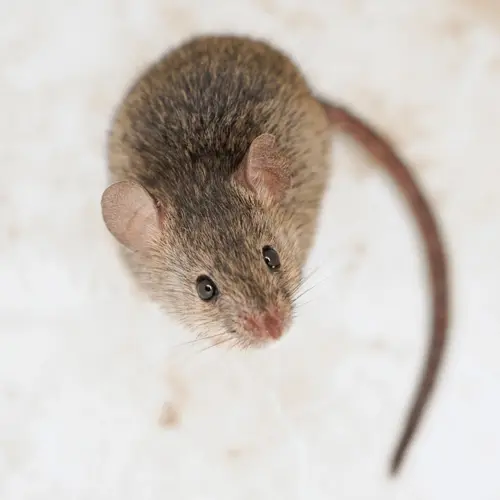
Both mice and rats are disease vectors, and this is not something to minimise. I mention it not to alarm people, but because it’s a real reason to act quickly and handle any cleanup carefully.
House mice are the primary carrier of Hantavirus in Canada. The virus is transmitted through contact with mouse droppings, urine, or saliva or by inhaling aerosolised particles from dried droppings during cleaning. Cases are rare but serious. Always wet-clean rodent droppings with disinfectant rather than dry sweeping.
Salmonella can be spread by both mice and rats through food contamination. Both species will enter pantry areas, chew through packaging, and contaminate food with droppings and urine.
Norway rats are associated with Leptospirosis, a bacterial infection spread primarily through rat urine. In urban areas with significant rat populations, this is a genuine concern particularly where rats have access to standing water sources.
Rat bite fever caused by bacteria transmitted through a rat scratch or bite is less common but worth knowing about if you’re handling live or dead rats without proper protection.
The practical takeaway: once you’ve identified which rodent you have and addressed the infestation, the cleanup process matters as much as the treatment. Use appropriate PPE, ventilate well, and wet-disinfect all affected surfaces before cleaning.
What to Do Once You've Identified the Rodent
For Mice
Start with snap traps placed perpendicular to walls, mice naturally travel along the edges of rooms and won’t typically cross open floor space. Use peanut butter, chocolate, or nesting material as bait (nesting material is often more effective than food for mice in established infestations). Place multiple traps in clusters of two or three in active areas, mice have small territories and you want saturation coverage.
Seal entry points at six millimetres or smaller use steel wool packed into gaps, followed by caulk or expanding foam. Pay attention to where pipes and wires enter walls, gaps around dryer vents, and deteriorated door sweeps.
For Rats
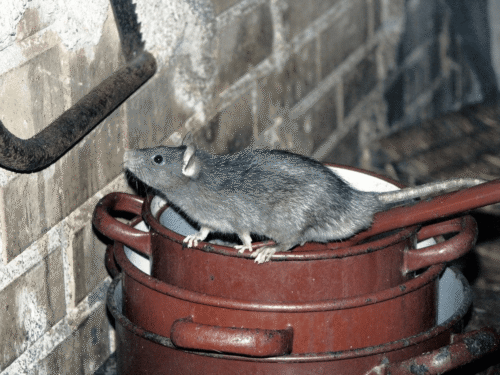
Rats require a different approach on every level. Snap traps need to be rat-sized Victor M326 or equivalent and they need to be placed correctly. Because of rats’ neophobia, leave unset traps in place for several days before setting them, to allow rats to become accustomed to the new objects in their runway. Pre-bait unset traps with high-quality bait bacon, fish, or nesting material before you actually set them.
Bait stations with rodenticide blocks are often more effective for larger rat infestations, but these require careful placement and responsible use, particularly in homes with children or pets. In Ontario, second-generation anticoagulant rodenticides require a licensed applicator this is one situation where calling a professional isn’t just convenient, it’s the regulated approach.
Seal Norway rat entry points at twelve millimetres or larger but remember that rats can gnaw through wood, foam, and soft materials. Use galvanised steel mesh (hardware cloth) with openings no larger than six millimetres for foundation gaps, and consider metal kick plates on wooden door frames in heavily affected areas.
Address any outdoor burrows as part of the treatment an untreated outdoor colony will repopulate an excluded home within weeks.
When to Call a Professional
I’ll give you my honest answer on this: mild mouse infestations caught early, a few droppings in one area, no obvious nesting, and a clear sense of where they’re entering can often be handled with diligent DIY treatment. If you act quickly, seal the entry point, and place traps correctly, you can resolve a minor mouse problem in two to three weeks.
Rats are a different conversation. In my experience, DIY rat control rarely solves the problem fully. Rats are intelligent, cautious, and well-established by the time most homeowners notice them. Missing one pregnant female means the infestation rebuilds. Missing an outdoor burrow means the treated interior gets repopulated. Missing an entry point means they’re back in the walls within days. The variables are just more complex, and the consequences of getting it wrong structurally and from a health perspective are more serious.
If you’ve found evidence of rats anywhere in your home, or if you’ve tried mouse treatment and the problem keeps coming back, it’s time to call a professional. At Pest Removal Toronto, we do a thorough inspection that covers both the interior of the home and the exterior perimeter including foundation gaps, utility entry points, and any outdoor burrow activity. We identify the species definitively, locate the entry points, and put together a treatment plan that addresses the actual problem rather than the surface symptoms.
Prevention: Keeping Both Mice and Rats Out
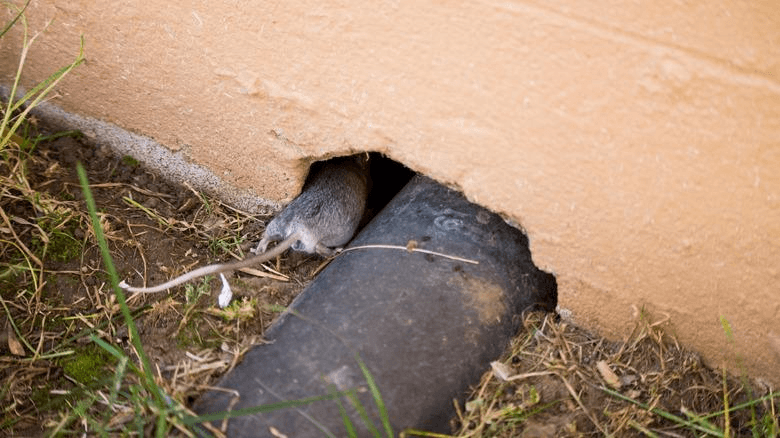
Once you’ve dealt with an infestation, prevention is what keeps them from coming back.
Seal your home methodically. Walk the exterior perimeter with a flashlight and look for any gap, crack, or opening larger than a pencil width. Pay special attention to where utilities enter the foundation, around vent covers, at the roofline where soffits meet the wall, and at any point where wood has deteriorated. Use galvanised steel mesh or metal flashing for larger gaps, foam alone won’t stop rodents.
Eliminate food and water sources. Store dry goods in airtight containers, heavy plastic or glass with secure lids. Don’t leave pet food out overnight. Fix dripping taps and leaking pipes. Even a small, consistent water source will make your home significantly more attractive to rodents.
Reduce outdoor habitat near the house. Keep grass and vegetation trimmed back from your foundation. Move firewood stacks at least three metres away from the house and store them elevated. Remove leaf piles and debris. Eliminate anything that provides ground-level cover close to your exterior walls, this is where Norway rats prefer to establish burrows.
Check your eavestroughs and roof. Blocked eavestroughs create moisture and debris accumulation that attracts rodents. Roof rats and mice both use tree branches that overhang the roofline as entry highways, trim any branches that come within one metre of your roof.
In Ontario’s climate, I recommend a seasonal inspection every autumn before temperatures drop, this is when rodents are actively seeking entry points and when catching a problem early saves the most time and money.
Conclusion
Correctly identifying whether you have mice or rats is the first, and most important, step in solving a rodent problem effectively. The droppings, gnaw marks, smear trails, nesting locations, and sounds inside your walls all tell a story, and understanding those signs can save you weeks of frustration and costly damage. In Toronto and across the GTA, rodent activity increases sharply during the colder months, which makes early detection and proper exclusion essential.
If you’re dealing with a small mouse issue, quick action with proper traps and sealing entry points can often solve the problem. But if the signs point to rats, especially Norway rats, professional treatment is usually the safest and most effective option. The sooner you identify the rodent correctly, the easier and less expensive the solution will be.
Are rats more dangerous than mice?
Both are health risks and both cause property damage. Rats tend to cause more structural damage due to their stronger teeth and larger gnaw marks, and they can compromise foundations through extensive burrowing. The disease risks are different for each species but both are real. From a control standpoint, rats are significantly harder to eliminate fully without professional help.
How quickly do rodent infestations grow?
Faster than most people expect. A single female mouse can produce up to sixty offspring per year. A Norway rat pair can produce a colony of several hundred within a year under ideal conditions. This is why acting at the first sign of activity, rather than waiting to “see how bad it gets” is always the right move.
How do I know if I have mice or rats without seeing them?
Start with the droppings, this is the most reliable evidence. Rice-grain-sized droppings scattered near food sources indicate mice. Larger, raisin-shaped droppings along walls and baseboards indicate rats. Dark smear marks along walls are almost exclusively a rat sign.
Do rodents go away on their own in winter?
No, in fact, the opposite is true in Canada. Rodents don’t hibernate and they seek warmth actively. Winter is when indoor rodent activity peaks in the GTA, not when it decreases.