
Every August, we receive calls from homeowners who notice stinging insects flying around their yards and homes. Many are concerned about their family’s safety, while others have already experienced a sting. In some cases, homeowners try to treat a nest themselves, which can make the situation more dangerous.
The first step is always proper identification. The insect you see may be a honey bee, yellow jacket, paper wasp, or European hornet. While they may look similar from a distance, each species behaves differently and requires a different approach. Misidentifying them can lead to unnecessary risks and more defensive insect activity.
With over 15 years of experience handling stinging insect issues across the GTA, we’ve encountered the common species found in Ontario. In this guide, you’ll learn how to identify wasps, bees, and hornets based on their appearance, behaviour, nesting habits, and seasonal activity.
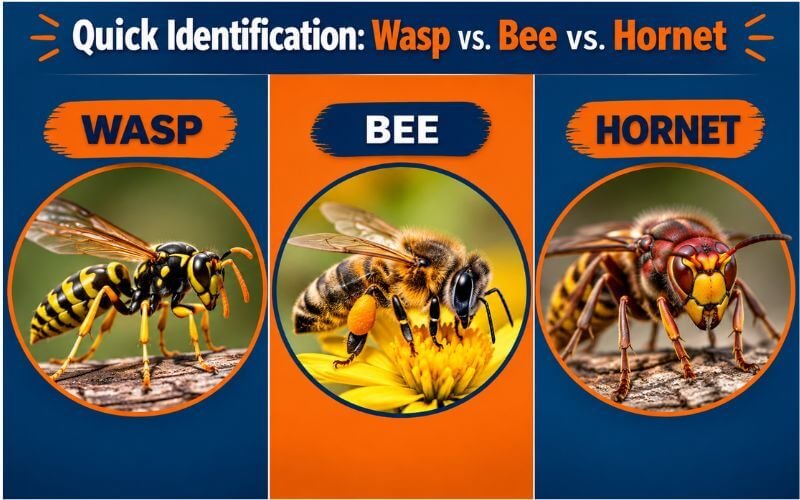
Quick Identification: Wasp vs. Bee vs. Hornet
Use this quick reference to match what you’re seeing before reading the full species breakdown below.
| Insect | Body/ Size | Colour | Nest | Aggression | Sting |
|---|---|---|---|---|---|
|
Honey bee |
Fuzzy, round; 12–15 mm |
Amber-brown with dark bands |
Wax honeycomb in cavities |
Low unless hive is threatened |
Barbed; typically one sting |
|
Bumble bee |
Very fuzzy, plump; up to 25 mm |
Yellow and black |
Ground burrow; small colony |
Very low |
Smooth; can sting multiple times |
|
Carpenter bee |
Fuzzy front; shiny black abdomen; 20–25 mm |
Black / yellow-black |
Round holes in wood |
Low; males have no stinger |
Smooth; females rarely sting |
|
Paper wasp |
Smooth, slender; about 15–25 mm |
Brown-red with yellow or yellow-black |
Open, umbrella-shaped paper nest |
Moderate when nest is disturbed |
Smooth; multiple stings |
|
Yellow jacket |
Smooth, compact; 12–15 mm |
Bright yellow and black |
Underground burrows, wall voids |
High, especially Aug–Sept |
Smooth; multiple stings |
|
Bald-faced hornet |
Smooth, robust; 18–20 mm |
Black with white/ivory markings |
Large, enclosed oval paper nest |
Very high near nest |
Smooth; multiple stings |
|
European hornet |
Smooth, elongated; 25–35 mm |
Brown with yellow-orange banding |
Hollow trees, wall voids, attics |
Generally lower unless threatened |
Smooth; multiple stings |
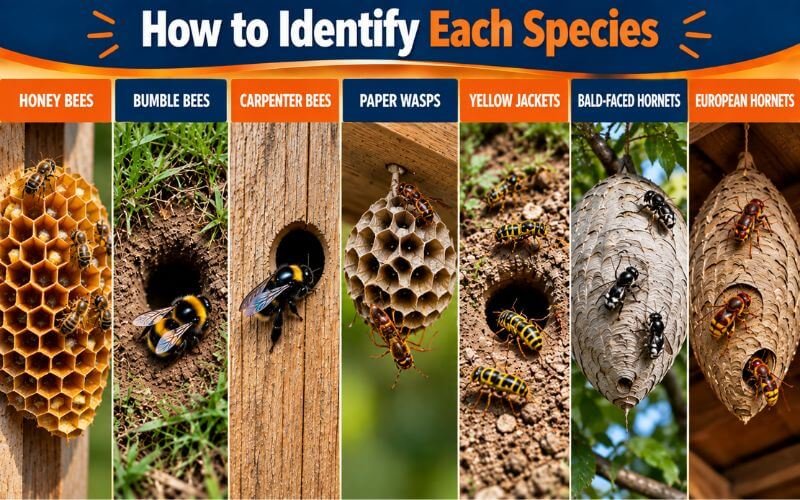
How to Identify Each Species
Honey Bees
Honey bees (Apis mellifera) are usually 12–15 mm long and have a golden-brown body with dark stripes. Their fuzzy appearance is a useful identification clue, and their body hairs help collect pollen.
They commonly return to the hive with pollen on their hind legs and spend much of their time visiting flowers. They are generally not interested in human food or sugary drinks.
Unlike wasps, honey bees have barbed stingers. After stinging, the stinger can become lodged in the skin, and the bee typically dies. Honey bees generally sting only when seriously threatened.
Their nests are made of wax honeycomb with distinctive hexagonal cells and are commonly found inside hollow trees, wall cavities, and other sheltered spaces.
Bumble Bees
Bumble bees are larger than honey bees and can grow up to 25 mm long. They have a round, robust body covered in thick yellow and black hair, giving them a very fuzzy appearance.
Most bumble bees build nests underground, often in abandoned rodent burrows or other sheltered spaces. Their colonies are relatively small compared with honey bee colonies.
Bumble bees are generally calm and non-aggressive. Stings are uncommon and usually occur when a bee is stepped on, trapped, or when its nest is disturbed.
If bumble bees are visiting your garden without creating a safety issue, they are usually providing valuable pollination and do not require treatment or removal.
Carpenter Bees
Carpenter bees look similar to bumble bees in size and colouring, but their abdomen is smooth and shiny black rather than fuzzy. Males have a yellow face patch; females are entirely black-faced.
The main giveaway is their nesting behaviour. Carpenter bees bore round holes, about 12 mm wide, into untreated wood such as decks, fascia boards, siding, and garden furniture. A small pile of frass may appear beneath an entry hole.
Males may dart around people but have no stinger. Females can sting but rarely do. The main concern is property damage rather than stinging.
What to do: Fill holes and paint, stain, or seal exposed wood. Carpenter bees strongly prefer bare, untreated surfaces.
Paper Wasps
Paper wasps (Polistes species) are long, slender wasps commonly found under eaves, on fences, in gutters, and beneath deck railings across the GTA. They have a narrow, pinched waist, smooth bodies, long dangling legs in flight, and yellow-and-brown or yellow-and-black colouring.
Their nest is a small, open-celled, upside-down umbrella shape made from grey paper pulp. The cells are visible from below.
Paper wasps are moderately defensive and will protect their nest if approached directly. They are generally less reactive than yellow jackets.
Paper wasp stingers are smooth, so they can sting multiple times. Small nests away from high-traffic areas can sometimes be left alone because paper wasps prey on caterpillars and other garden pests.
Nests near entry doors or children’s play areas should be assessed carefully and, when treatment is necessary, handled professionally.
Yellow Jackets
Yellow jackets (Vespula species) are small about 12–15 mm with a bright yellow-and-black banded body, no visible hair, a narrow waist, and rapid flight.
They are often mistaken for honey bees. Yellow jackets are smooth and shiny, while honey bees are fuzzy. Yellow jackets also tend to show rapid, darting flight and are frequently attracted to food and sugary drinks.
Yellow jackets commonly nest underground, including in abandoned rodent burrows, under concrete slabs, beneath decking, and in wall voids. Because the entrance can be difficult to spot, people may disturb a colony without realising a nest is nearby.
Late summer is a peak period for yellow jacket activity. Mature colonies and increased food-seeking behaviour can bring them into closer contact with BBQs, soft drinks, fruit, patios, and outdoor gatherings.
What to do: Do not attempt to treat an active yellow jacket ground nest yourself. A disturbed colony can rapidly defend the nest, so professional assessment and treatment are the safer approach.
Bald-Faced Hornets
Bald-faced hornets (Dolichovespula maculata) are technically wasps rather than true hornets, but they are commonly called hornets because of their size and the large, enclosed nests they build. They are about 18–20 mm long and are black and white, with a distinctive ivory-white face.
Their nest is a large, oval, enclosed structure made from grey paper pulp, with a small entrance near the bottom. Nests are commonly attached to tree branches, shrubs, utility poles, or home eaves.
Bald-faced hornets are highly defensive of their nest. They can sting repeatedly and may respond quickly when the colony perceives a threat.
What to do: Avoid approaching or disturbing an active nest, especially near people or frequently used areas. Professional treatment is appropriate when removal is necessary.
European Hornets
The European hornet (Vespa crabro) is the only true hornet species established in Canada. It is large about 25–35 mm with a brown and yellow body.
European hornets can be active at night. Finding a large brown-and-yellow insect around outdoor lights after dark can be a useful identification clue, although appearance should still be checked.
They nest in hollow trees, old barns, wall voids, and attic spaces. Their paper nests are often hidden from view.
European hornets are generally less defensive than yellow jackets or bald-faced hornets unless their nest is directly threatened. Nests inside wall voids or attics should be professionally assessed.
How to Identify a Nest: When You Haven’t Seen the Insect Clearly
Honey bee hive: Wax honeycomb in a cavity, wall void, hollow tree, or wooden box. Distinctive hexagonal wax cells help distinguish it from wasp and hornet nests.
Paper wasp nest: An open, umbrella-shaped paper nest with cells facing downward, usually hanging from a single stalk. It is never fully enclosed.
Bald-faced hornet nest: A large, oval, enclosed grey paper nest with a single entrance near the bottom. It can become very large by late summer.
European hornet nest: An enclosed nest inside a hollow tree, barn, wall, or attic. It is often less visible because it is built inside a cavity.
Yellow jacket nest: An underground entrance where yellow jackets come and go. The colony can be concealed beneath soil or other structures.
Carpenter bee nest: A perfectly circular hole bored into wood siding, deck boards, fascia, or fence posts. Each female creates her own gallery.
Seasonal Patterns in Ontario: When Each Insect Is Most Active
Spring (April–May): Queen wasps and queen hornets emerge from overwintering and begin building new nests. Honey bee swarms are commonly seen in May and June as established colonies divide.
Early summer (June–July): Colonies grow. Carpenter bees are actively boring and laying eggs, bumble bee colonies are establishing, and European hornets may begin appearing around lights at night.
Late summer (August–September): Many stinging insects are highly active. Yellow jacket colonies are mature, bald-faced hornet nests are fully developed, and wasps are frequently attracted to carbohydrates at outdoor gatherings.
Autumn (October–November): Most colonies decline as temperatures cool. Mated queens typically survive to overwinter, while old seasonal wasp and hornet nests are not reused the following spring.
Should You Remove the Nest Yourself?
Honey bee swarms and established hives: Contact a beekeeper as a first step when relocation is appropriate. Honey bees are beneficial pollinators.
Bumble bee nests in low-traffic areas: Leave them undisturbed when they are not creating a safety issue.
Paper wasp nests: Small nests away from high-traffic areas may sometimes be left alone. Nests close to entrances or play areas should be professionally assessed.
Yellow jacket ground nests, bald-faced hornet nests, and nests inside structures: These situations can involve defensive colonies and concealed access points. Professional treatment is the safer option.
Professional Stinging Insect Removal in the GTA
At Pest Removal Toronto, we handle stinging insect removal throughout the GTA, including Toronto, Brampton, Mississauga, Etobicoke, Scarborough, and North York. We identify the species first, assess the nest location and colony size, and recommend the appropriate approach.
We also advise on whether removal is necessary. Not every stinging insect nest needs to be eliminated, and in some situations leaving the nest alone is appropriate.
Prevention: Reducing Stinging Insects Around Your Home
Seal structural entry points: Inspect and seal gaps in soffits, exterior cladding, and utility penetrations to reduce opportunities for yellow jackets and European hornets to enter wall voids and attics.
Maintain exterior wood: Carpenter bees prefer untreated, weathered wood. Paint, stain, or seal exposed wood surfaces.
Cover food and drinks: Especially from August onward, keep food containers, sugary drinks, compost, and other attractants covered or removed.
Manage fruit and waste: Remove overripe fruit and keep waste containers closed to reduce accessible food sources.
What to Do If You’re Stung
Most stinging-insect encounters cause a local reaction such as pain, swelling, and redness. Remove a honey bee stinger promptly if one is present. A cold pack can help reduce swelling, and an over-the-counter antihistamine may help with itching when appropriate.
Seek emergency medical attention immediately if you experience throat tightening or difficulty swallowing, widespread hives, dizziness or lightheadedness, difficulty breathing, or other signs of a severe allergic reaction. If you have been prescribed epinephrine for a known allergy, use it as directed and call emergency services.
Multiple stings from a disturbed yellow jacket or hornet colony can also require medical evaluation, even without a known allergy.
Final Words
The buzzing insect in your yard may be a bee, wasp, or hornet, and identifying it correctly is the first step. Look at body texture, waist shape, size, colour, behaviour, and when safe the type and location of the nest before taking action.
If you’re not sure what you’re dealing with, or you’ve found a nest that concerns you, Pest Removal Toronto can help with identification, assessment, and stinging-insect removal across the GTA.
Frequently Asked Questions
Bees are generally hairier and more rounded, while wasps are smoother, slimmer, and have a more pronounced narrow waist. Nest location and behaviour can also help.
No. Defensive behaviour varies by species and situation. Many bees and some wasps are not interested in people unless they or their nest are disturbed.
Keep people and pets away from the area and avoid disturbing the nest. Because underground colonies can defend the nest quickly, professional assessment is recommended.
Seasonal wasp and hornet colonies die off in autumn, and old nests are not reused the following spring.
Activity varies by species, but late summe especially August and September is a period when mature colonies and increased food-seeking behaviour can bring many wasps and yellow jackets into closer contact with people.
Females can sting but rarely do. Males may behave defensively around people but do not have a stinger. Carpenter bees are more commonly a property-damage concern because they bore into wood.