
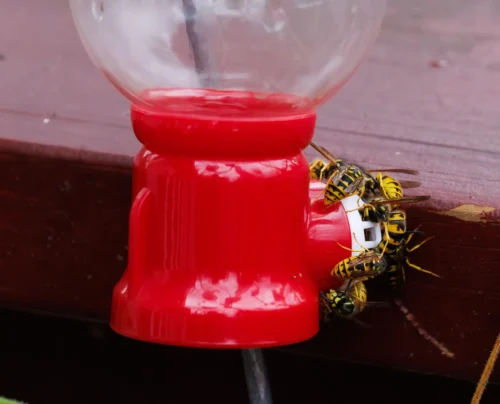
The timing of the wasp feeder problem in Ontario is not random. It’s directly tied to the yellow jacket colony life cycle.
Through spring and early summer, a yellow jacket colony is growing. The queen is laying eggs, and worker wasps are hunting insects to feed protein-hungry larvae. During this phase, wasps have abundant natural food sources and relatively little interest in sugar feeders.
Then August arrives. The queen slows egg-laying. The larvae stop producing the sugary liquid that adult workers supplement their diet with. Natural insect prey becomes scarcer. Suddenly, thousands of workers in a large late-summer yellow jacket colony need to find carbohydrate sources urgently. Hummingbird nectar essentially has the same sugar concentration as natural wasp food- becomes one of the most attractive sources available.
This is why wasp pressure on hummingbird feeders in Ontario builds so dramatically in August and September. It’s not that new wasps have arrived. It’s that the colony’s food needs have shifted completely, and your feeder is meeting those needs perfectly.
There‘s also a colour factor. Wasps, particularly yellow jackets, are strongly attracted to the colour yellow. Many traditional hummingbird feeders include yellow port covers or yellow accents that act as a visual beacon. Combined with the sweet smell of fermented nectar, a yellow-accented feeder in August is essentially a wasp welcome sign.
Method 1 — Switch to a Saucer-Style Feeder
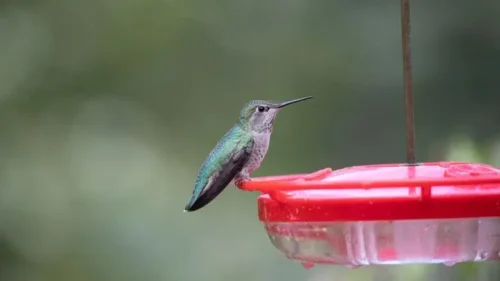
This is the single most effective structural solution, and the one I recommend first to any Ontario homeowner with a serious wasp feeder problem.
A saucer feeder, sometimes called a dish feeder, holds hummingbird nectar in a shallow reservoir below the feeding ports rather than in an inverted bottle above them. Because the nectar sits below the port level, wasps and bees cannot reach it from above. Hummingbirds, with their long tongues, extend through the port and reach the nectar with ease. Wasps, with their short tongues, cannot access it.
This design removes physical access rather than simply deterring. A wasp that cannot reach the nectar gives up and moves on, no pheromone signals, no establishing the feeder as a food source, no persistent problem.
Saucer feeders like the HummZinger series are widely available at Canadian Tire, at Wild Birds Unlimited locations in Ontario, and from online retailers that ship to the GTA.
Method 2 — Install Bee Guards / Nectar Guard Tips
Bee guards are small plastic or mesh screens fitted over feeding ports of traditional hummingbird feeders, extending the distance between the feeder surface and the nectar inside. A hummingbird’s long bill and tongue pass through the guard easily. A wasp’s shorter mouthparts cannot reach the nectar.
Nectar guard tips, like WBU Nectar Guard® Tips available at Wild Birds Unlimited stores across Ontario, work on the same principle and retrofit many standard feeder designs.
When purchasing bee guards, ensure they are clear or white, not yellow. Some commercially available guards are yellow, which partially defeats the purpose by attracting the same wasps you are trying to deter.
Method 3 — Apply Vegetable Oil or Vaseline Around Port Openings
Wasps use a gripping, clinging action to access feeder ports. They land on the rim and grip the surface while feeding. A slippery surface prevents the grip needed to feed.
Apply a very thin layer of vegetable oil or petroleum jelly (Vaseline) around the exterior rim of each feeding port using a cotton bud. Do not apply inside the port where it could contact the nectar or transfer to a hummingbird’s bill. Reapply every few days or after rain.
Hummingbirds hover while feeding and never grip the port rim, so this thin coating does not affect them. Wasps require a stable footing and give up when they cannot get one.
Apply sparingly; too much oil can drip and create a messy surface where dirt sticks. Less is more.
Method 4 — Relocate the Feeder
Wasp foragers learn the exact location of a food source and communicate it to nestmates through pheromone signals. However, wasps are far less motivated than hummingbirds to search for a relocated food source.
Move the feeder three to five metres, even just to the other side of your deck or across the garden. Hummingbirds are highly motivated foragers that will find a relocated feeder within hours. Wasp foragers that return to the original location will hover briefly, fail to find food, and in many cases give up without locating the new position.
This works best when done early in the wasp problem, before many colony foragers have memorised the location. If the feeder has been swarmed for several days, combine relocation with the other methods below.
Method 5 — Hang a Fake Wasp Nest Nearby
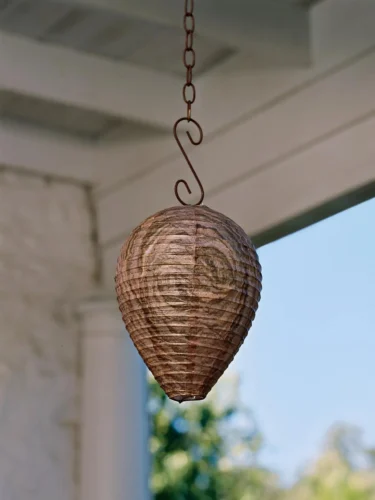
This is the method that surprises people the most, and it’s one of the most effective behavioural deterrents available.
Wasps are highly territorial. A yellow jacket or paper wasp colony will not establish a nest in a location where it believes another wasp colony is already active. Commercially available fake wasp nests, paper ball structures mimicking a bald-faced hornet or paper wasp nest, exploit this instinct. When foraging wasps encounter what looks like an established wasp territory, they typically divert away.
Critical step most guides skip: remove any active wasp nests in your yard before hanging the fake one. A fake wasp nest deters wasps that haven’t yet established themselves in an area. If an active colony is already nearby, the fake nest does not affect them. At Pest Removal Toronto, we recommend professional removal of any active wasp nest near the feeder zone first, followed by hanging the fake nest deterrent before new queens begin scouting in spring.
Hang the fake wasp nest in a sheltered spot, protected from direct rain, within visual range of the feeder. Replace annually as it deteriorates.
Method 6 — Clean the Feeder Every Two to Three Days
Fermented nectar is one of the most powerful wasp attractants at a hummingbird feeder, and it is entirely preventable.
Hummingbird nectar begins fermenting within two to four days in warm weather, producing volatile compounds that smell strongly of alcohol and sugar, a scent that wasps can detect from a significant distance. A feeder that hasn’t been cleaned in a week is broadcasting an attraction signal continuously.
Disassemble the feeder completely, scrub all parts with hot water and a small brush (rinse thoroughly if using dish soap; residue can harm hummingbirds), and refill with fresh nectar. Clean any spilled nectar on the exterior immediately.
🧪 The Safe Hummingbird Nectar Recipe:
1 part plain white granulated sugar (Do NOT use honey, brown sugar, or red dye).
4 parts clean water.
Boil briefly to dissolve sugar and kill bacteria, then let it cool completely before filling.
Make the nectar solution at the standard ratio, one part white sugar to four parts water, without extra sugar. A more concentrated solution ferments faster and attracts more wasps.
Method 7 — Use Shade Placement to Reduce Fermentation
Where you hang your hummingbird feeder affects how quickly nectar ferments and how far the scent travels.
Direct sunlight accelerates nectar fermentation, increases the sweet vapour dispersing into the air, and creates a scent plume that wasps detect from further away. Moving the feeder to a shaded location, under a tree canopy, beneath a pergola, or on the shaded side of the house, slows fermentation and reduces the attraction signal.
Hummingbirds are attracted by the feeder itself, not sunlight. A shaded feeder keeps nectar fresher longer, reducing cleaning frequency and consistently offering better-quality food for the birds. Position in dappled shade, filtering light rather than full shadow, for best results in GTA gardens.
Method 8 — Set Up a Decoy Sugar Dish for Wasps
Rather than fighting wasps at the hummingbird feeder itself, redirect them to a dedicated alternative.
Place a shallow dish, a saucer, or a jar lid, filled with slightly more concentrated sugar water (one part sugar to three parts water) at least ten metres from your hummingbird feeder. Make it easy for wasps to access — shallow enough that they will not drown.
Wasp foragers that discover this decoy source will preferentially visit it over the more difficult-to-access hummingbird feeder, particularly once the feeder has been fitted with bee guards or switched to a saucer design. Establish the decoy dish in late July before the August surge for the best results.
Keep the decoy dish well away from seating and activity areas. You are redirecting wasps, not inviting them to your patio.
Method 9 — Switch to Red-Only Feeder Colours
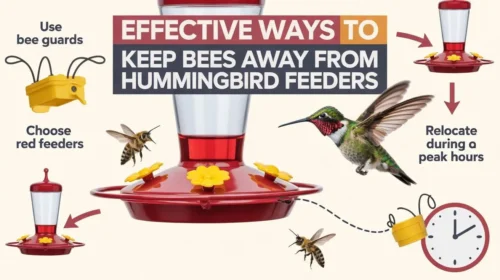
Research consistently shows that wasps and bees are strongly attracted to yellow. Many hummingbird feeders include yellow port covers or yellow accents that act as a wasp beacon. Choose a feeder with all-red or all-clear components and no yellow elements.
If your current feeder has yellow port covers, check whether the manufacturer offers replacements in red, white, or clear. Eliminating the visual attraction signal reduces the number of initial wasp visitors that discover the feeder in the first place, though this works best as part of a combined approach rather than as a standalone fix.
Never use insecticides or sprays near a hummingbird feeder. Even trace pesticide residue near the feeder can be toxic to hummingbirds. A ruby-throated hummingbird weighs about three grams, their sensitivity to chemical exposure is extreme. The Cornell Lab of Ornithology explicitly advises against any pesticide use near feeders. There is no safe amount of spray near a hummingbird feeder.
Never apply oil directly to the feeder pole without an ant moat above. Cooking oil or Vaseline on the pole creates a hazard for hummingbirds; oil on feathers destroys their insulating and waterproofing properties. For ant barriers on the pole, use a commercial ant moat with water, positioned above the feeder.
Method Comparison Table
| Method | Effectiveness | Effort | Cost | Safe for Hummingbirds? |
| Saucer feeder | ⭐⭐⭐⭐⭐ Highest | Low — one-time switch | Moderate | ✅ Yes |
| Bee guards / nectar guards | ⭐⭐⭐⭐ High | Low — retrofit | Low | ✅ Yes |
| Vegetable oil on ports | ⭐⭐⭐ Moderate | Low — reapply regularly | Free | ✅ Yes (thin layer) |
| Feeder relocation | ⭐⭐⭐ Moderate | Low | Free | ✅ Yes |
| Fake wasp nest | ⭐⭐⭐⭐ High | Low — hang once | Low | ✅ Yes |
| Regular cleaning | ⭐⭐⭐⭐ High (prevention) | Medium — every 2–3 days | Free | ✅ Yes |
| Shade placement | ⭐⭐⭐ Moderate | Low | Free | ✅ Yes |
| Decoy sugar dish | ⭐⭐⭐ Moderate | Low | Free | ✅ Yes (position away) |
| Red-only feeder colour | ⭐⭐ Supporting | Low | Varies | ✅ Yes |
My GTA field recommendation: Combine saucer feeder or bee guards (physical barrier) + cleaning every 2–3 days (scent elimination) + fake wasp nest (territorial deterrent). If there is an active wasp nest within twenty metres of the feeder, have it professionally removed first. These three combined address physical access, chemical attraction, and territorial behaviour simultaneously — the most reliable way to restore hummingbird visits by late August.