
24/7 AVAILABLE 647-847-9898

24/7 Emergency Service Available
CALL 647-847-9898

9 Clear Signs of Mice in Walls (And How to Confirm an Infestation)

It was a Tuesday night in October when a North York homeowner called me. She’d been hearing scratching sounds in the walls every night around ten, right after the house went quiet. She tried to convince herself it was just the house settling, but she wasn’t imagining things.

The next morning, I found mouse droppings behind her stove, grease marks along the baseboards in the hallway, and shredded insulation in a kitchen cabinet. The colony had already been living inside her walls for nearly a month.

Mice never announce their arrival. By the time homeowners in Toronto, Brampton, Etobicoke, or Scarborough notice a problem, the mouse infestation is already well established. This guide covers every proven signs of mice in wall, simple DIY confirmation tests, indicator of wall-dwelling mice and how to gauge the severity of the problem before deciding on next steps.

🔍 What's Inside Your Walls? A Quick Acoustic Guide

Before diving into the full signs, sit quietly and identify the specific type of sound you are hearing right now. This helps determine whether you are dealing with rodents or other structural pests:

  • Scurrying & Moving Scratching (Nighttime): 🐭 Most likely mice or rats moving between the wall studs. The sound clearly travels from one spot to another.

  • Clicking, Ticking, or Stationary Chewing: 🐜 Often carpenter ants or termites working inside the wood. The sound typically stays in one exact location.

  • Heavy Thumping, Thudding, or Rolling: 🦝 Usually larger wildlife like raccoons or squirrels nesting near the attic, roofline, or wide wall drops.

Why Mice Get Into Walls in the First Place

Why Walls Attract Mice

Wall voids, the empty cavities between your drywall, insulation, and exterior sheathing, offer everything a mouse needs: warmth, shelter, darkness, and close proximity to food sources.

In Ontario, mouse pressure on homes peaks between October and December as temperatures drop. The house mouse (Mus musculus) needs warmth year-round, making a heated Canadian wall the most attractive real estate on the block.

Mice enter through gaps as small as six millimetres (the diameter of a pencil) and follow plumbing lines or electrical runs. Because they travel entirely hidden within the structure, signs of mice often appear far from their actual exterior entry points.


Sign 1 — Scratching, Scurrying, and Gnawing Sounds at Night
Gnaw Marks & Wiring Damage

This is almost always the first indicator that reaches a homeowner’s awareness. Because mice are nocturnal, they remain quiet during daylight hours and become active roughly one hour after dark, once human activity stops.

Here’s how to distinguish the specific sounds:

  • Scratching or scurrying: A light, quick scrambling noise. You can often track it moving horizontally or vertically as the pest travels through the void. This tracking quality differentiates rodents from insects, whose sounds remain fixed in one spot.

  • Gnawing sounds: A repetitive, rhythmic chewing noise. Mice must chew constantly to wear down their ever-growing incisors. This sounds like faint scratching that targets wooden framing, pipe penetrations, or the edges of wiring.

  • Squeaking: A high-pitched, thin vocalisation. Squeaking from inside a wall confirms you are dealing with a group or a developing colony rather than a single intruder.

  • Rustling: A softer, papery sound indicating nesting behaviour as mice manipulate insulation, plastic bags, or paper inside the void.

Field Test: Tap the wall firmly with your knuckle where you hear the noises. If you hit a hollow-sounding section that feels slightly softer than the rest of the drywall, it often indicates a spot where mice have cleared out the insulation behind it.

Sign 2 — Mouse Droppings Near Walls and Baseboards
Mouse Droppings

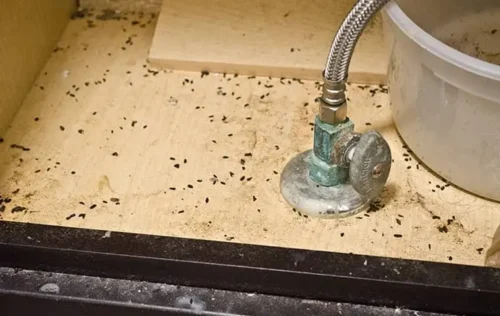
A single house mouse produces between 50 and 75 droppings per day. These droppings are small (roughly 3–6 mm long), dark brown to black, with pointed ends, resembling the size and shape of a grain of rice.

The freshness of droppings is your most important confirmation tool. Fresh droppings are dark and slightly moist, while older ones fade to grey, dry out, and become brittle.

To confirm active movement, follow this simple field routine:

  1. Put on disposable gloves and dampen the area with a disinfectant spray.

  2. Clean up every piece of evidence along baseboards, behind the stove, and inside cabinet corners.

  3. Recheck the exact same spots 24 hours later.

If new droppings appear, you have an active mouse infestation requiring immediate attention. If no new signs appear after 48 hours, the activity has either paused or shifted to another zone of the house. Look closely inside lower kitchen unit corners, behind major kitchen appliances, under the sink, and along basement foundation sills.

Sign 3 — Grease Marks and Rub Marks Along Baseboards and Walls

This is the sign that confirms an established infestation, not a random visitor, but mice that have been using the same route consistently for weeks or longer.

Mice have oily, greasy fur, and they navigate by running along walls and baseboards, pressing their bodies against the surface because they have poor eyesight and use walls as a guide. Over time, this deposits a dark, greasy smudge mark along their regular travel routes. These are called rub marks or grease marks, and once you know what to look for, they’re unmistakable.

They appear as slightly darkened, smudgy streaks along the base of walls, typically at baseboard height or just above it. They’re most visible against light-coloured walls and painted surfaces. On darker surfaces, run your finger along the baseboard: the greasy residue will transfer.

The more defined and extensive the grease marks, the longer the infestation has been established. Fresh, faint marks suggest recent activity. Dark, thick, well-defined marks suggest mice have been running the same route for months.

I found classic grease marks in that North York home I mentioned, along a section of hallway baseboard that the homeowner had assumed was just scuff marks from the vacuum. It wasn’t.

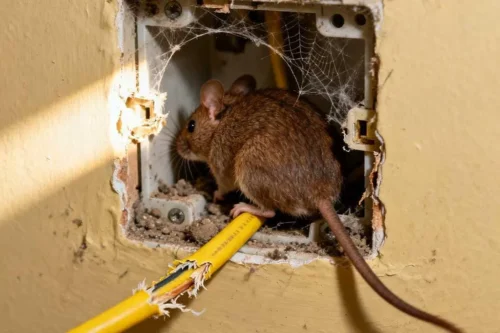
Sign 4 — Gnaw Marks on Walls, Baseboards, Wiring, and Food Packaging

Mice gnaw on everything, not because they’re hungry for wood or drywall, but because their incisor teeth never stop growing. Constant chewing is biological necessity, not destructive intent.

Gnaw marks on walls and baseboards typically appear near entry points, around pipe penetrations, and at the base of walls where mice squeeze through tight gaps. The marks are small and rough-edged, quite different from the larger, more forceful damage left by rats. Fresh gnaw marks are pale and light-coloured. Older gnaw marks darken over time.

Gnaw marks on wiring are the sign I take most seriously from a safety perspective. Mice chew through the plastic insulation on electrical wiring inside wall voids and chewed wiring is one of the leading causes of house fires in Canadian homes. If you find any evidence of mice near your electrical panel, in areas where wiring runs through the wall, or you experience unexplained electrical issues, treat this as urgent.

Gnaw marks on food packaging, chewed corners on cereal boxes, small holes in bags of rice or flour, are a sign that mice have access to your pantry. Paired with droppings and wall sounds, this confirms an active kitchen infestation.

Sign 5 — The Flour Test and Other DIY Confirmation Methods

Here’s something almost none of the generic pest control articles mention, and it’s one of the most useful things I can teach a homeowner: you can confirm mouse activity without seeing a single mouse.

The flour test: Sprinkle a thin, even layer of plain flour or talcum powder on the floor directly against the baseboard in any area where you suspect activity, behind the stove, along a basement wall, near a pipe penetration. Keep it undisturbed overnight. Check it in the morning.

Mouse footprints in flour are distinctive: four small toes on the front feet (creating a four-point print roughly 1.5 cm wide), five toes on the hind feet (slightly larger). You’ll also often see a thin line running between the footprints, the tail drag mark. Even a single set of clear footprints in the flour tells you definitively that a mouse crossed that area overnight.

The UV torch test: This is my personal go-to on inspections, and very few homeowners know about it. Mouse urine fluoresces under UV light, it glows a pale blue-white colour when illuminated with an ultraviolet torch in a darkened room. Hardware store UV torches cost around twenty dollars and take about five minutes to reveal urine trails, splash patterns, and runway marks that are completely invisible in normal daylight. Shine it along baseboards, under kitchen units, inside cabinets, and along wall edges. The results are often startling for homeowners who thought the area was clean.

The drop-test recheck: As described above, clean all droppings, mark the location, recheck after 24 hours. New droppings = active infestation. No new droppings = check other areas or reassess.

These three tests together give you more certainty than most homeowners would ever expect to have before calling a professional.

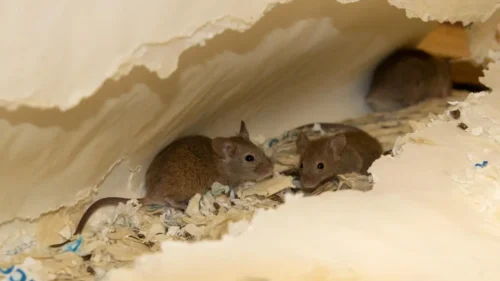
Sign 7 — Nesting Material and Disturbed Insulation

Mice build nests from any soft, shreddable material they can find: insulation fibres, shredded newspaper, fabric scraps, cotton, paper towels, and similar materials. Finding a nest, or signs of nesting material being gathered, is one of the most definitive confirmations of an established infestation.

Common nesting locations inside walls: behind the insulation in exterior wall cavities, inside the hollow space beneath kitchen cabinets, behind the dishwasher, inside the cavity beneath the floor in an uninsulated crawl space, and in any void near a heat source. Mice prefer warmth, which is why nests cluster near the furnace room, water heater, and the backs of refrigerators.

Signs that nesting is happening inside a wall: small pieces of fibrous material appearing from a baseboard gap, insulation fibres scattered near a wall penetration, or the rustling sound described earlier that starts and stops in short bursts.

If you access a crawl space or unfinished basement and find insulation that’s been pulled out of place, torn into pieces, or gathered into a mounded cluster, mice are almost certainly the cause.

Sign 8 — Pet Behaviour Changes

Your cat or dog may confirm a mouse infestation in your walls before any of the other signs become obvious to you. Animals can detect both the ultrasonic squeaking mice produce and the scent of mouse urine well before these are detectable to humans.

Signs to watch for: a cat or dog repeatedly returning to sniff or scratch at a specific wall section, staring intently at the gap beneath a baseboard or appliance, or behaving unusually agitated near a particular area of the hous,  particularly at night. I’ve had clients tell me their cat had been “obsessed” with a section of kitchen baseboard for days before the droppings appeared. The cat knew first.

If your pet is unusually focused on a specific wall, cabinet, or floor section, take it seriously. Get down and look carefully at that area for gnaw marks, droppings, grease marks, and gaps in the baseboard. It’s worth investigating before dismissing it.


Sign 9 — Seeing a Mouse During Daylight Hours
Seeing Mice During the Day

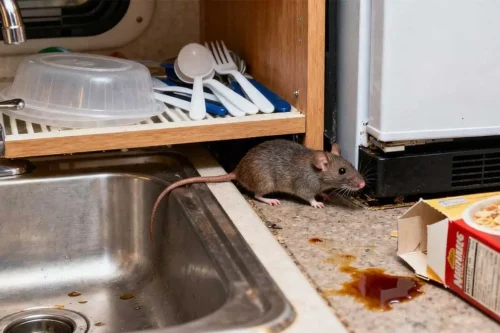
Here’s a sign that tells you the infestation is already serious: spotting a live mouse during the day.

Mice are nocturnal and strongly prefer to avoid any environment with human activity. A healthy mouse with a functioning colony will rarely if ever expose itself during daylight hours. When you see a mouse in broad daylight, running across the kitchen floor, crossing the hallway, disappearing behind the stove, it almost always means one thing: the colony has grown large enough that competition for space is pushing younger and lower-ranking mice out during daylight hours.

In pest control, daytime sightings are what we call a “severe infestation” indicator. The same applies to hearing mice in your walls during the day rather than just at night. If the sounds are present around the clock rather than just after dark, the population has likely expanded significantly.

How to Gauge How Serious the Infestation Is

What You’re Finding What It Indicates Urgency Occasional sounds at night only Early stage, mouse recently entered Act within a week Droppings in one location, no new ones after 24hrs Possibly historic activity, monitor closely Inspect entire home Fresh droppings in multiple rooms Established active colony. Act immediately. Rub marks on baseboards. 

Long-term infestation (weeks to months) Professional inspection Nesting material foundColony breeding inside the structure Professional treatment Daytime mouse sighting Severe over crowded infestation Professional treatment, urgent Chewed wiring or electrical issues Serious structural and fire hazard Professional treatment, urgent Dead mouse smell from inside wall Deceased mouse in wall cavity Professional removal to cut dry wall UV torch reveals extensive urine trailsColony well-established, multiple runwaysProfessional treatment

Ontario-Specific Seasonal Patterns — When to Be Most Alert

This is context specific to Canadian homeowners that almost no pest control content addresses, and it genuinely changes how you should respond.

October and November are the highest-risk months for mice entering GTA homes. As outdoor temperatures in Ontario drop below five or six degrees Celsius, house mice begin actively seeking warm shelter. Your home, with its accessible wall voids, proximity to food, and central heating, is ideal. The freeze-thaw cycle that Ontario goes through in late autumn also opens up new cracks in foundations and mortar every year, creating fresh entry points even in homes that were previously secure.

December through March is when established indoor mouse colonies breed and expand. A single female mouse can produce five to ten litters per year, with five to six pups each. A colony that entered your walls in October can be a significantly larger population by February.

April is when homeowners often “discover” infestations that have been growing all winterm, not because the mice are new, but because warmer days increase activity and homeowners do more spring cleaning that reveals the accumulated evidence.

My recommendation for Ontario homeowners: do a thorough exterior inspection and exclusion check every September, before the mice are looking for entry. Fresh caulk around foundation gaps, pipe penetrations, and door frames costs thirty minutes and prevents the October surge. If you’ve already heard something in the walls, don’t wait until spring.

Call a professional if:

Professional pest control technician

You’ve confirmed active mouse droppings in more than two separate areas of the home. This indicates a colony that’s ranging widely and likely nesting inside the structure rather than at the perimeter.

You’re finding rub marks along multiple baseboards, this means mice have established several regular runways, suggesting a population that has been present for some time.

You can smell mouse urine in multiple rooms or the smell is strong  indicating significant accumulation and an established nest nearby.

You’ve found chewed wiring or have experienced unexplained electrical issues — this is a safety emergency, not just a pest problem.

You’ve caught one mouse in a trap, and the activity is continuing, catching one mouse rarely solves the problem. There are almost always more.

At Pest Removal Toronto, every mouse infestation inspection follows the same process: we trace the active runways using rub marks and droppings, locate the nest, identify every entry point around the exterior perimeter, and seal them with galvanised steel mesh or metal flashing before we leave. We treat the interior with properly sized snap traps or bait stations, depending on the property and the family’s situation, and we come back to confirm the colony has been fully eliminated.

Final Thought — The Cost of Waiting

The most expensive mouse infestations I deal with in the GTA are not the ones homeowners call about immediately. They’re the ones people waited on  convinced the sounds would stop, assuming the single dropping was a fluke, telling themselves they’d deal with it after the holidays.

By January or February, what was a manageable early-stage entry has become an established colony with multiple nesting sites, chewed wiring, damaged insulation, and contaminated kitchen areas. The treatment is more extensive, the exclusion work is more involved, and the repair costs are higher.

If you’ve read this far and you recognise two or more of the signs I’ve described use the flour test tonight. It costs nothing, takes five minutes, and gives you a definitive answer by morning. Then you’ll know exactly what you’re dealing with and exactly what to do next.

Frequently Asked Questions

How do I know if it's mice or rats in my walls?

The sounds are the fastest clue. Mice produce lighter, higher-pitched scratching and their sounds are trackable as they move across the wall. Rats produce heavier, more distinct thudding sounds and are more commonly heard in basements and lower wall cavities. Mouse droppings are rice-grain size (3–6 mm) with pointed ends; rat droppings are raisin-sized (12–20 mm) with blunt ends. Grease marks from rats are heavier and darker than mouse rub marks.

Yes, and this is not an exaggeration. Mice chew through wiring insulation inside wall voids continuously. Exposed wiring can arc and ignite insulation or surrounding materials. A significant number of unexplained house fires in Canada are traced back to rodent damage to electrical wiring. If you have any evidence of mice in areas where wiring runs, treat it as urgent.

Easily three to four weeks before most homeowners notice anything — and in some cases much longer. The North York homeowner I described at the start had been hearing sounds for two weeks before she called, and the evidence I found suggested the colony had been present for at least a month before that. Mice are quiet, cautious, and good at staying out of sight.

Pests in Your Home?

Licensed pest control technicians near you, serving all Toronto neighbourhoods. Free inspection. Same-day service.

Free Estimate