
24/7 AVAILABLE 647-847-9898

24/7 Emergency Service Available
CALL 647-847-9898

How Do Wasps Make Their Nests? A Pest Expert Explains the Whole Fascinating Process

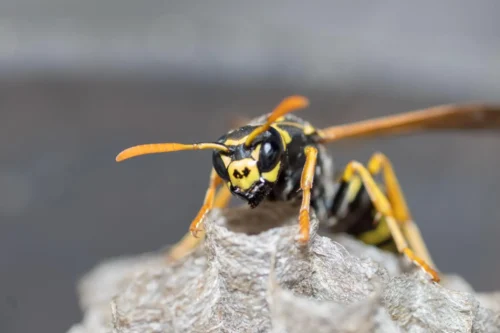
Wasps make their nests by chewing weathered wood fibres  from fences, dead branches, or wooden structures and mixing them with saliva to create a papery pulp. This pulp is moulded into hexagonal cells and layers, then dries to form the familiar grey paper structure. The process begins with a single queen wasp in spring and is taken over by worker wasps as the colony grows

I found my first truly impressive wasp nest in a wall cavity of a semi-detached home in Etobicoke  it was October, the colony was dead, and a section of drywall had been removed during a renovation. What was inside stopped everyone in the room.

The nest was roughly the size of a rugby ball. It had at least twelve distinct layers of hexagonal cells, each perfectly formed, arranged in descending combs with precise air spaces between them. The outer shell was a layered, papery grey structure that looked almost like artisan papier-mâché. And every single bit of it had been built by insects the size of a thumbnail, from nothing but chewed wood and saliva.

The homeowner looked at it for a long moment and said:

“I can’t decide if that’s incredible or terrifying.”

I told him it was both. And after fifteen years of pest control work across Toronto, I still think that every time I find one.

This guide covers the full process, how do wasps make their nests from scratch, what materials they use, how different species build differently, and what the nest can tell you about what you’re dealing with. Because understanding how wasp nests are made is genuinely useful knowledge for any Ontario homeowner.

What Are Wasp Nests Actually Made Of?

Before we get into the process, let’s answer the material question directly  because it surprises most people.

Wasp nests are made of paper. Not commercial paper, obviously  but a remarkably similar material produced entirely by the wasps themselves. The technical term for the process is maceration: wasps chew raw wood fibres, mixing them thoroughly with saliva as they chew, breaking the fibres down into a paste-like pulp. When this pulp is applied and dries, it hardens into a lightweight, rigid, paper-like material.

 The Raw Ingredients

  • Weathered, softened wood: Old fence boards, dead tree branches, bark, wooden garden furniture, and any dry timber that’s begun to break down.

  • The Problem with Fresh Wood: Fresh, hard wood is more difficult to chew and yields poorer-quality pulp. This is why wasps are so commonly seen investigating old fence panels and the weathered timber of sheds and outbuildings in Ontario yards they’re sourcing building material, not looking for food.

  • Enzymatic Saliva: The saliva plays a critical role beyond just binding the fibres. It contains enzymes that help break down the wood cellulose during maceration, and chemical compounds that harden as the pulp dries  giving the finished nest material its characteristic rigidity.

The result is a material that’s lightweight relative to its strength, thermally insulating, and surprisingly weather-resistant. This is why wasp nests look the way they do  that rippled, layered, grey-brown surface is the direct result of individual wasps applying successive strips of pulp in overlapping layers, exactly the way a papier-mâché artist would build up thickness and strength.

The Queen Builds First — Alone

The Queen Builds First

The wasp nest building process begins in spring, and it begins with a single insect working entirely alone.

After overwintering in a state of dormancy called diapause  tucked into an attic void, under bark, inside a wall cavity, or in some other sheltered spot  a fertilised queen wasp emerges when temperatures consistently reach around 10°C. In the GTA, this typically happens in late April to mid-May.

Her first task is finding a suitable location. She’s looking for somewhere that’s dry, sheltered, and structurally sound  somewhere that can support the weight of a growing nest and protect it from rain and direct wind. Common queen choices in Ontario include:

  • The underside of roof eaves, soffits, and fascia boards.

  • Attic rafters and rooflines where different materials meet.

  • Tree branches in sheltered spots or inside wall cavities.

  • Under deck boards and inside the hollow cavities of bird boxes or garden ornaments.

The Architectural Blueprint

  1. The Petiole Anchor: Once she’s selected her site, the queen begins construction by building the petiole a short, narrow anchor stalk that attaches the nest to the surface. This petiole is critical: it’s the structural connection point that will eventually bear the weight of the entire colony.

  2. The First Inverted Cup: From the petiole, the queen builds outward and downward  constructing the first few hexagonal cells that form the initial comb.

  3. The Nursery Setup: She lays one egg in each cell, seals it temporarily, and continues building new cells as she goes. At this stage, the structure is tiny  perhaps the size of a large grape  and it’s doing double duty as both nursery and living quarters for a colony that doesn’t yet exist.

Expert Field Tip: This early-spring phase is the window that Ontario homeowners most often miss. A queen working alone on a small structure is very easy to deal with  the nest is small, there’s no defensive colony, and the risk is minimal. By the time most people notice a wasp nest, the queen’s solo work is long finished.
Workers Take Over — The Nest Expands Rapidly

Workers Take Over

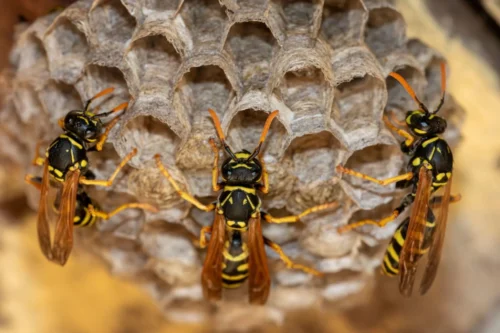
The queen’s eggs hatch into larvae, which she feeds with chewed insects and sugary food until they pupate and emerge as adult worker wasps  all of them female. This typically happens in late June in Ontario.

From this point, the dynamic changes entirely. The queen transitions to a single role: laying eggs. Every other task  foraging for food, feeding larvae, and critically, nest construction  is taken over by the workers.

  • Relentless Builders: Each worker makes repeated trips to collect wood fibres, returns to the nest, macerates the material, and applies it to the growing structure.

  • Downward Growth Vector: Here’s one of the most fascinating structural details that almost nobody knows about wasp nests: they grow downward, not upward. New comb layers are added below the existing ones, connected to the layer above by small pillars that also create the air spaces between combs.

  • Thermal Insulation Cores: These air spaces serve as insulation  trapping heat inside the nest to keep the developing larvae at the right temperature  and as corridors that allow workers to move between levels without disturbing developing cells.
How Fast Does a Wasp Nest Grow?

This is the question I hear most often from Ontario homeowners who’ve spotted a small structure in spring and wondered whether to be concerned. The answer is: faster than almost anyone expects.

  • Late April / Early May: Queen alone, tiny nest, roughly the size of a walnut or a golf ball within the first two to three weeks.

  • Mid-June: First workers emerge  the structure quickly balloons to the size of a tennis ball.

  • Late July: With a colony of several hundred workers all building simultaneously, the nest reaches the size of a grapefruit.

  • August (Peak Wasp Season): An established wasp nest can easily become the size of a football or basketball, containing thousands of cells across multiple comb layers, housing 2,000 to 10,000 workers depending on the species.

The practical implication is significant: A nest that would take ten seconds to remove with a broom handle in May becomes a serious professional removal job by August. Early action costs minutes; late action costs much more.

Why Are Wasp Nests Hexagonal?

The engineering behind these structures is genuinely remarkable:

  • Geometrical Efficiency: Each hexagonal cell in a wasp nest is approximately 5–7 mm across sized precisely for the species building it.

  • Shared Wall Design: The walls between cells are shared, meaning each wall serves double duty and no material is wasted. The hexagonal geometry means that when cells are packed together, they fill space completely with 0% wasted gaps.

  • Optimal Stress Distribution: A wasp nest comb achieves high structural rigidity from a material (dried paper pulp) that isn’t particularly strong in isolation because the geometry distributes stress efficiently across the entire structure.

  • Cell Recycling: Cells are not just built and used once. After an adult worker wasp emerges from a cell, the cell is cleaned and repaired by other workers and reused for the next generation of eggs, preserving the colony’s energy.

How Different Wasp Species Build Differently


How Different Wasp Species Build DifferentlyNot all wasp nests are the same  and in Ontario, the species you’re dealing with determines both what the nest looks like and where you’ll find it. Here’s a breakdown of every common species.

 1. Paper Wasps (Polistes species)

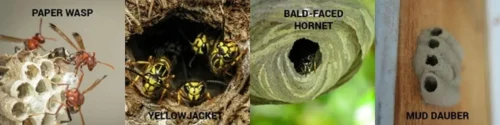
  • The Architecture: An open umbrella shape  a single flat comb of hexagonal cells with the cell openings facing downward, suspended by a central petiole from an attachment point above. There is no outer envelope layer enclosing the comb.

  • Common GTA Locations: Under roof eaves and fascia boards, under deck rails, behind window shutters, inside window frames, and under the lip of gas BBQ lids (one of the most common spots I find them in Brampton and Mississauga).

  • Risk Profile: Typically small to medium in size, rarely larger than a dinner plate. They are moderately defensive rather than highly aggressive.

 2. Yellow Jackets (Vespula species)

  • The Architecture: Fundamentally similar internal hexagonal cells in multiple comb layers, but completely enclosed in a thick, protective outer envelope made from paper pulp material.

  • Underground Nests: They readily take over abandoned rodent burrows, cavities beneath concrete slabs, and soil voids near foundations. In late summer, an underground yellowjacket nest can extend a metre into the soil, housing thousands of workers.

  • Structural Cavities: They exploit gaps in exterior cladding, deteriorated soffit sections, and cavities in garage walls. I’ve found hidden nests inside wall cavities across the GTA that were 30 to 40 cm across, entirely invisible from outside.

3. Bald-Faced Hornets (Dolichovespula maculata)

  • The Architecture: A massive, oval, enclosed nest with a thick multi-layer outer envelope. The outer surface has a characteristic rippled, layered appearance with a striped or marbled effect built from different shades of grey paper pulp.

  • Common Locations: Attached to tree branches, utility poles, shrubs, or eaves  always elevated above ground level. They regularly grow to basketball size or larger by late August in areas like Scarborough and North York.

  • Risk Profile: Highly defensive of their nest; they will mobilize the colony rapidly if threatened.

 4. European Hornets (Vespa crabro)

  • The Architecture: Canada’s only true hornet species. They build similarly to bald-faced hornets but typically within enclosed cavities like hollow trees, inside wall voids, behind exterior cladding, and in attic spaces.

  • Risk Profile: Often not directly visible  you detect the colony by seeing large hornets entering and exiting a gap, often active after dark.

5. Mud Daubers

  • The Architecture: These are solitary wasps (no colony, no defensive workers). Their nests are completely different: constructed from wet mud, shaped into long, cylindrical tubes roughly the diameter of a finger, and attached to garage walls or concrete foundations.

  • Risk Profile: They pose no meaningful sting risk. These are harmless structures that can simply be scraped off with a putty knife.

What a Wasp Nest Tells You About What You’re Dealing With

In my fifteen years of pest control inspections across the GTA, I’ve found that the nest is almost always the most reliable identifier  often more useful than trying to catch or identify the fast-flying insect itself.

Nest AppearanceSuspected SpeciesAction Protocol
Open umbrella comb, cells facing down, single petiole anchorPaper WaspSmall nests away from traffic can be monitored; near doors or seating requires treatment.
Large oval enclosed nest, grey marbled paper surface, single bottom entryBald-Faced HornetAlways professional treatment, do not approach under any circumstances.
Enclosed nest hidden inside hollow tree, attic, or deep wall voidEuropean HornetProfessional treatment required; typically discovered by watching the flight path entry point.
Underground entrance hole with high-frequency trafficYellowjacketProfessional treatment required, never run a lawnmower over this area.
Perfect mud cylinders / tubes on concrete or garage wall

My Professional Field Rule: If the cells are visible from outside  it’s a paper wasp. If the nest is fully enclosed with a single entrance hole it’s a hornet. If it’s underground or hidden in a structural void  it’s almost certainly a yellowjacket. Each one requires a completely different response.

Ontario-Specific Context: GTA Nest Locations to Watch

Here’s local field knowledge specific to Canadian home construction types that general internet articles completely fail to mention:

  • Vinyl Siding & Soffit Gaps: This is the #1 nest entry point I find in GTA homes. Modern Ontario homes are frequently clad in vinyl siding with small gaps along the top and bottom edges  gaps that are perfect for yellowjacket queens seeking warm wall voids in May.

  • Gas BBQ Lids: A reliably productive spot for paper wasp queens. The enclosed space inside the lid is warm, sheltered, and undisturbed for weeks. I get calls every June from homeowners who’ve lifted the BBQ lid for the first time since Victoria Day and found an active nest inside.

  • The Ontario Seasonal Timeline:

    • Late April to May: Queen alone  tiny nest, minimal risk, easiest removal window.

    • June: First workers emerge nest growing, small but now actively defended.

    • July: Colony expanding exponentially  nest becomes structurally significant.

    • August to September: Peak colony season  maximum nest size, maximum wasp aggression, high patio risk.

    • October: First hard frost hits  colony dying, nest being actively abandoned.

    • November Onwards: Nest completely empty  100% safe to remove yourself.

When to Remove a Wasp Nest — And When to Call a Professional
When to Remove a Wasp Nest

✔️ Safe to Remove Yourself:

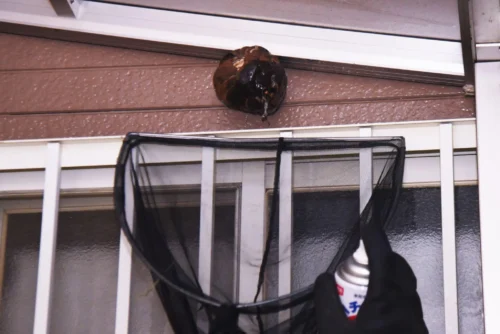
  • Any nest found in October or later  the colony is dead or dying due to winter temperatures, and there are no defensive workers inside.

  • A solitary mud dauber nest at any time of year, no colony defense mechanisms exist.

  • A tiny paper wasp nest (golf-ball size or smaller) in early spring before the first workers hatch.

❌ Always Call a Professional:

  • Any underground or hidden yellowjacket nest  the combination of colony size, hidden location, and fierce defensive aggression makes DIY treatment genuinely dangerous.

  • Any bald-faced hornet nest larger than a tennis ball  their defensive sting radius extends several metres beyond the nest.

  • Any nest located inside a structural wall cavity  specialized entry and aerosol injection tools.

  • Any situation where a resident has a known severe venom allergy or risk of anaphylactic shock.

At Pest Removal Toronto, every wasp nest removal starts with precise species identification  because the species determines the treatment method, the safety protocol, and the exclusion approach. We treat all stinging insect infestations across the GTA safely, quickly, and effectively.

Frequently Asked Questions

How long does it take wasps to build a nest?

How long does it take wasps to build a nest? A queen working alone builds a golf-ball-sized starter nest in two to three weeks. Once workers emerge in June, the nest grows rapidly, reaching tennis-ball size by late June and potentially basketball size by August.

No. Wasp nests are never reused. Every spring, a new queen builds a completely new nest from scratch. The old nest naturally deteriorates over winter and will not be recolonised. However, a new queen may choose the exact same spot if the structural shelter remains ideal.

Wasp nests are made from a specialized paper pulp — wood fibres chewed from weathered wood and mixed with enzymatic saliva through a biological process called maceration. It is not wax (that’s bees) and not mud (except for solitary mud daubers).

Final Word

That nest in the Etobicoke wall, the rugby-ball-sized, twelve-layer architectural masterpiece built entirely from chewed fence boards and insect saliva was built in one summer by workers that lived perhaps six weeks each. Thousands of individual contributions, each wasp adding its small portion of pulp, each generation of cells feeding the next generation of builders.

Understanding how wasp nests are made doesn’t make them any less of a pest problem when they’re in the wrong location. But it does make it easier to identify what you’re dealing with, when to act, and what action is appropriate.

If you’ve found a wasp nest on your property and you’re not sure what you’re looking at reach out to Pest Removal Toronto. We’ll identify the species, assess the risk, and give you an honest recommendation. Sometimes that’s professional treatment. Sometimes it’s “leave it alone, they’ll be gone by November.”

Either way, you’ll know exactly what you’re dealing with.

Pests in Your Home?

Licensed pest control technicians near you, serving all Toronto neighbourhoods. Free inspection. Same-day service.

Free Estimate